Most people don't think about drywall until it's cracked, water-stained, or still covered in popcorn texture from 1978. Then they call three contractors, get three bids that are nowhere close to each other, and have no idea why. Here's what actually separates a bid worth taking from one you should walk away from.
Check the license, not just the truck
In California, drywall work beyond small patch jobs should be done by someone holding a C-9 drywall contractor license or working under a general B license, and that number is checkable on the CSLB website in about thirty seconds. Ask for it before you ask for a price. A contractor who hesitates on this, or tells you a license doesn't matter for a job this small, is telling you something. Insurance matters just as much. If a guy falls off a ladder hanging 4x12 sheets in your garage and he's not covered, that liability can land on you as the homeowner.
This matters more in Antioch than people assume, because a lot of the housing stock here spans a wide range of ages. You've got older homes near the downtown core and the Rivertown area that are 70, 80, even 100 years old, with real plaster or old blueboard behind the drywall layer added later. You've got the postwar and 1970s-80s tract neighborhoods off Lone Tree Way and around Prewett Ranch, where you'll find nail pops showing up on ceilings as the original framing lumber finishes drying out and shrinking, sometimes decades after the house was built. And you've got newer subdivisions out toward Deer Valley and the hills built in the 90s and 2000s, where the drywall is newer but the bids still vary wildly because the work itself hasn't changed.
Ask what's actually in the bid
A real bid breaks down square footage, the number of coats, and what kind of joint compound and tape they're using. Paper tape set in joint compound holds up better long-term than self-adhesive mesh tape, especially on butt joints where panels meet mid-wall, though mesh paired with a setting-type compound like Durabond is fine for a lot of repair work. Screws should land 12 inches on center on ceilings and 16 inches on center on walls, into the studs, not just floating in the mud. If a bid doesn't mention any of this, it's probably priced off a guess, and guesses are where corners get cut once the job starts.
Three coats of compound is standard for a taped joint: the embedding coat, a fill coat, and a final skim coat feathered out 10 to 12 inches wide so the seam disappears under paint. Each coat needs real drying time between passes. In Antioch's summer heat, with July and August regularly hitting the high 90s and sometimes past 100, compound can skin over fast on the surface while staying wet underneath, especially in a closed-up garage. A contractor who pushes a second coat on top of that too soon is setting you up for shrink cracks that show up weeks later, right after you've painted.
Texture and finish level, where corners actually get cut
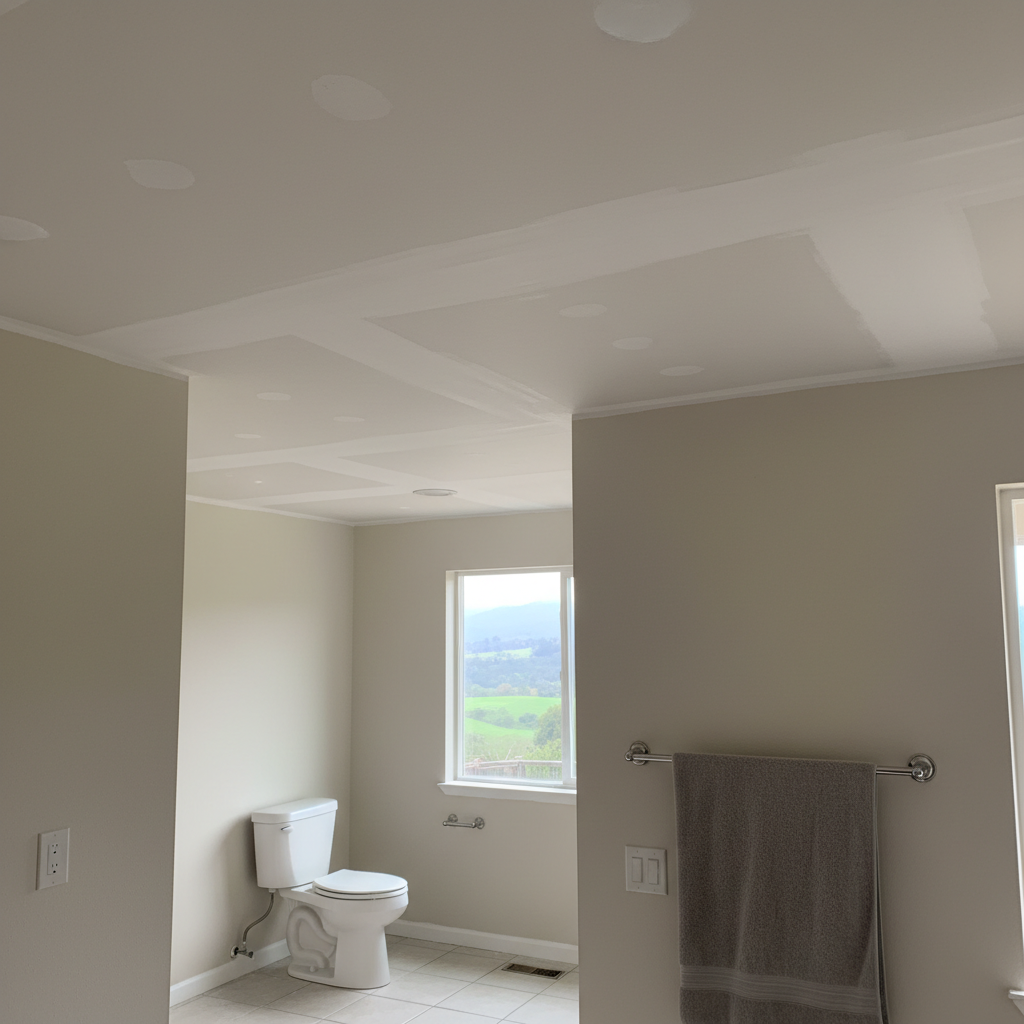
Texture matching sounds simple until you're staring at a patch that doesn't blend because the surrounding wall has knockdown texture and the patch got sprayed with orange peel, or worse, hand-troweled smooth. A contractor who's done this a while will test the texture on a scrap board first and check it against your wall in daylight, not under a work light, before committing to the whole room. If you're after a skim coat or Level 5 finish, meant to eliminate flashing under raking light from windows or recessed cans, that's a slower, more expensive process involving a thin coat of compound over the entire surface, not just the joints. Anyone quoting Level 5 work at the same price as a basic Level 4 taped finish either doesn't know the difference or isn't planning to do it.
If your home was built before 1980 and still has original popcorn ceiling texture, don't let anyone scrape it dry without testing for asbestos first. It's a cheap test and a real one, not a formality. A contractor who skips straight to scraping without mentioning it at all is a reason to walk.
Permits and what the city actually checks
For straightforward patch and repair work, the City of Antioch's Building Division usually doesn't require a permit. Once the job involves removing and re-hanging drywall tied to electrical, insulation, or a garage conversion, a permit is normally expected, and the inspector will want to see the fire-rated assembly before it gets covered back up. Garage walls shared with living space need 5/8-inch Type X drywall for the one-hour fire rating, taped and mudded at the seams, not just hung and left. A contractor who's worked here knows when a permit applies and pulls it instead of hoping no one notices. If you're in an HOA community, which covers a fair number of the newer subdivisions on the east side of town, check whether exterior-facing work or garage conversions need HOA sign-off too, separate from the city.
What to walk away from
- A bid with no square footage, no coat count, and a single lump sum number.
- Anyone who wants full payment in cash up front before materials are bought.
- A scraper and a bucket showing up to remove popcorn texture with no mention of asbestos testing on a pre-1980 house.
- A rushed timeline that has three coats of mud going on in one day in a closed room with no fans or ventilation.
- No written scope at all, just a verbal agreement and a handshake.
None of this is complicated once you know what to ask. A good contractor will walk you through the coats, the drying time, and the fire rating without being asked twice, because it's just how the job gets done right. That's the kind of detail we build every bid around at Rockwell Drywall Company, whether it's a single patched hole or a full garage re-hang.